Founded in 1976, for 50 years OLIN has been driven by deeply held values that today define our singular mission: to create places that enhance life.
We invite you to explore the legacy of OLIN projects that have shaped our current practice and influenced the landscape architecture profession. For us, this is beyond a retrospective. It is a reflection that prompts OLIN forward. Inquiry and craft have always driven our ethos but how do we apply this data-driven legacy to the urgent crises of the 21st century? It is an active evolution of our practice to leverage 50 years of evidence to design for climate action and social and environmental resilience.
Since our beginnings as Hanna/Olin, later Olin Partnership, now simply OLIN, we are a practice that believes in multigenerational leadership. We believe in new perspectives and hard-won insights that come through years of experience. As a design studio, we’ve always been a creative, open studio with our heads and hearts principally embedded in the public realm. In the words of our founder, ‘Transforming the Common Place’ is about building a better commons for us all. It’s not simple work; it was borne through novel research, intensive involvement in academia, and deeply collaborative partnerships.
These lessons drive us to humanize infrastructure, and reseed life in grey and brown fields on the ground and even on the roofs of our urban terrains.
Join us as we explore how 50 years of practice, partnership, and design excellence are propelling our next chapter in building a more equitable, resilient, and beautiful world.
Yes! It’s been 50 years of CREATING PLACES THAT ENHANCE LIFE. Now we’d like to reflect on what we mean when we say it, and how we do it.
OLIN’s signature is not a style or palette. It is a dedication to craft, a commitment to quality, collaboration, and a genuine interest in the human condition, paired with the expertise to respond to the complex challenges of the 21st century inherent in our communities and landscapes @scale.With deliberation and clarity, we create transformative places that bring new life while honoring past and extant cultural, natural, and social conditions.
You can trace this evolution directly through our work. In the late 1980s, our public realm design for London’s Canary Wharf set a powerful new baseline for transforming post-industrial urban fabric into vibrant, democratic civic space. Today, we build on that foundational legacy with projects like the Bud and Susie Rogers Gardenat the Akron Art Museum and Grace Farms in Connecticut. These contemporary landscapes reach beyond civic gathering; they function simultaneously as deeply integrated cultural commons and vital, regenerative ecological havens.
From human-centered affordable housing, to inspirational environments for the arts, to invaluable local parks, to economic hubs, to innovative campuses, OLIN seeks to transform the everyday lived experience of landscape to one of connection and inspiration—for ALL.
A landscape is best understood by how it performs. OLIN has evolved in a symbiotic relationship with the places where we learn, work, and play—leading us to continuously explore the complex intersections of evolving programmatic needs, workplace culture, and ecological repair through physical design.
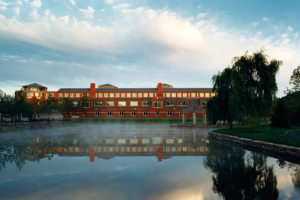
1970’s Corporate America was moving from city centers to bucolic, multi-acre sites—often former industrial brownfields and agricultural fields. Re-imagining the workplace landscape beginning with J&J Baby Products, OLIN advocated for what was then considered “messy” nature—meadows, hedgerows, and stormwater systems presented a radical shift for corporate sensibilities.
Since then, OLIN has advanced sustainable practices through both innovative and expertly executed traditional techniques: capturing heat from mainframe computing to protect microclimate-sensitive biomes; engineering site-wide stormwater reuse to support mechanical systems; submerging building programs for built-in climate control and to minimize landscape encroachment; and recharging water tables through deft grading and ancient wall-building methods.
Today, as companies edge back toward urban centers, leadership, employees, and communities expect far more than aesthetic integration, demanding high-performance, regenerative design. In collaboration with visionary project teams—and driven by the rigorous inquiry of our Eco Lab—OLIN remains at the forefront of ecological systems integration. These achievements can be seen at our landmark campus projects like Apple Parkand Google Bay View.The Google Bay View landscape is recognized globally for its regenerative capacities, closed-loop water sustainability, and amenities—fostering both ecosystem health and human wellbeing. Apple Park restores native Californian ecology at a massive scale, seamlessly integrating immense environmental performance with iconic architecture.
Moving forward, we aren’t just carrying these lessons with us; they are our baseline. We continue to design landscapes that do more than adapt—they actively restore our planet’s biodiversity, design in true partnership with nature, and build resilience for an undeniably changing future.
What does resilience actually mean? For much of the 20th century, the answer was static: higher sea walls, thicker concrete revetments, and rigid infrastructure designed to hold back nature. At OLIN, we know that true resilience requires a paradigm shift toward self-healing, living infrastructure. And crucially, we understand that physical infrastructure is only half the equation—true resilience is deeply rooted in social cohesion and community strength.
A community’s ability to withstand trauma doesn’t just rely on how well a plaza absorbs a flood; it relies on the everyday social connections of neighbors who support each other in the aftermath. As we often say in our practice, “Parks are the ultimate flexible infrastructure to help our communities face and rebound from emergencies.”
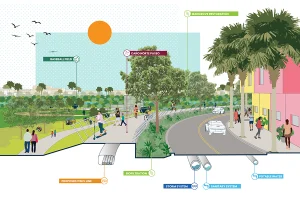
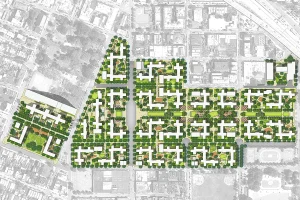
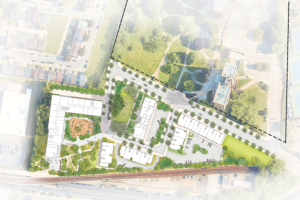
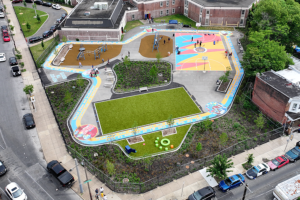
This duality of physical and social resilience is the core of our environmental justice work. At NYCHA Red Hook in Brooklyn and through our comprehensive planning for Caño Martín Peña in Puerto Rico, we are designing with and for historically marginalized communities. By creating vibrant, hyper-local public realms, we help foster the vital social networks necessary to withstand climate impacts.
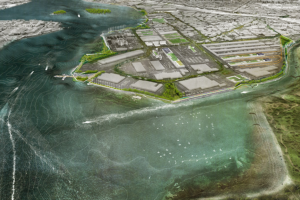
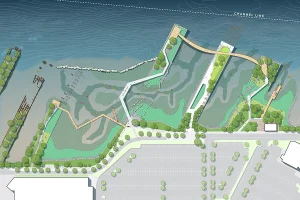
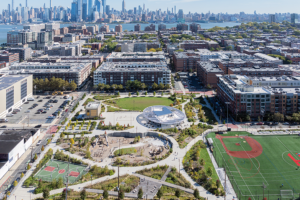
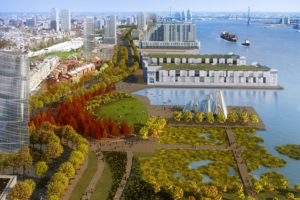
Physically, we are replacing outdated concrete with dynamic landscapes built to absorb the shock of a changing climate. At ResilienCity Park in Hoboken and the Hunts Point peninsula in the Bronx, the landscape itself is the infrastructure. These spaces act as natural sponges and protective shields—capturing millions of gallons of stormwater, mitigating urban heat, and protecting critical food supply chains—all while functioning as beautiful, accessible neighborhood parks.
As OLIN looks to our next 50 years, we will continue to champion designs where ecological repair and social cohesion are one and the same. Because creating places that enhance life means creating places that protect it, too.
OLIN’s planning practice has evolved from traditional urban design into a community-driven process underpinned by innovative spatial analysis.
Over the past decade we’ve deepened our understanding to realize environmentally-just planning. Empowered by our People and Tech Labs research, we don’t just ask what goes where, but who benefits, whose voices are missing, and how we can use design to repair historic inequities. Centering community needs through data-driven, equitable planning strategies, we restore the ecological and social health of entire regions.
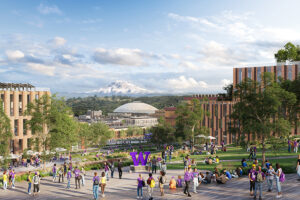
OLIN’s practice is rooted in a desire to understand the human condition. In our seminal collaboration with urban sociologist Holly Whyte at Bryant Park, we used direct behavioral observation to decisively alter how public spaces serve people who use them. You can trace the evolution of our planning practice directly through our work. Our early, localized visioning for UW Tacoma in the 1990s set a strong precedent for integrating new development seamlessly with the surrounding community fabric—work we were fortunate to continue with an updated Campus Plan in 2025.
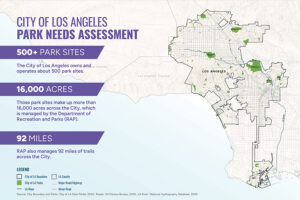
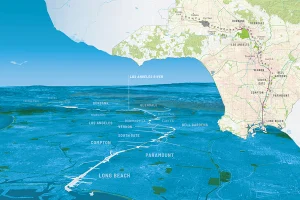
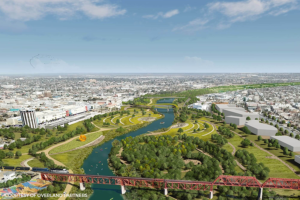
Now we apply that community-focused rigor at an unprecedented regional scale. Projects like the LA River Master Plan and the LA Countywide Comprehensive Parks & Recreation Needs Assessment are global benchmarks for multi-benefit, equity-driven systems planning. These are comprehensive roadmaps for distributing resources, mitigating climate risks, and providing essential public space to millions of residents. OLIN continues to plan for the future of some of the world’s most iconic landscapes, urban districts, and rural communities in partnership with governments, non-profits, and institutions.
Looking toward the next generation’s needs, we continue to strengthen our core skills for elevating planning as it relates to the landscape and our site design projects. From land use planning at large scales to water conservation to resilience to park systems planning, we believe planning at the scale of the impacts we have on our landscape is critical to a thriving future. Our best future is one we design together, recognizing the value we all bring to the table.
“Tell me and I forget, teach me and I may remember, involve me and I learn.”
— B. Franklin, Founder of the University of Pennsylvania, 1740
Standing on Ben’s shoulders, we are grateful to reflect on our work in Philadelphia, where our country was founded 250 years ago, and where our practice began 50 years ago. With Philadelphia serving as OLIN’s launch pad and living laboratory, we embrace Franklin’s wisdom, actively designing together with our communities, building more equitable futures spanning the breadth of the city.
The West: Our origin story begins at the University of Pennsylvania’s Graduate School of Fine Arts, today’s Weitzman School of Design, where two professors, Bob Hanna and Laurie Olin, collaborated with other faculty to create the University of Pennsylvania Campus Development Plan.
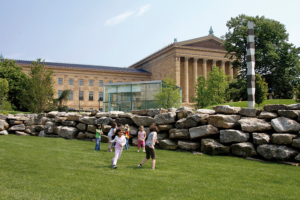
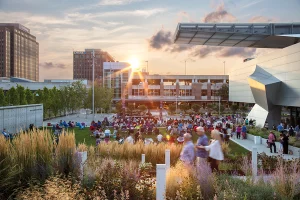
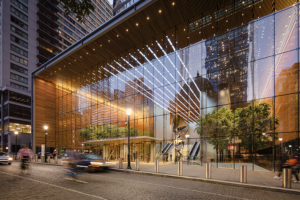
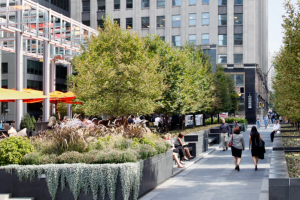
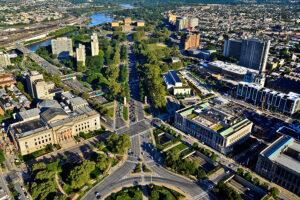
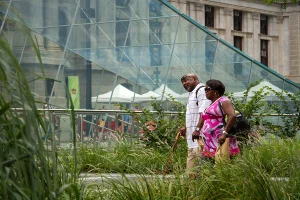
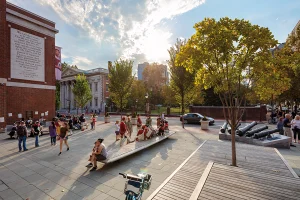
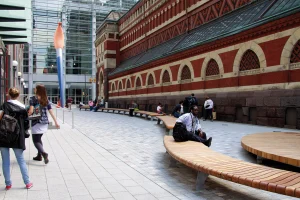
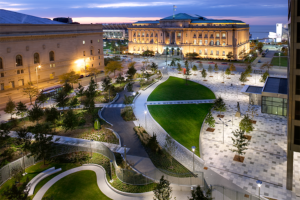
The Center: On the historic Ben Franklin Parkway, we designed multiple restorations, museum grounds, and event spaces—starting with the Philadelphia Art Museum gardens and reaching to the democratic civic space at Dilworth Park—enhancing Philadelphia’s cultural spine. Comcast Plaza merges the public realm with a welcoming plaza in the working heart of Center City.
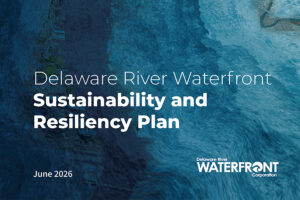
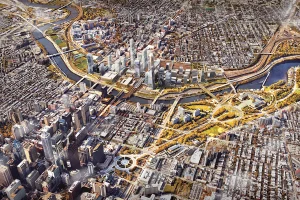
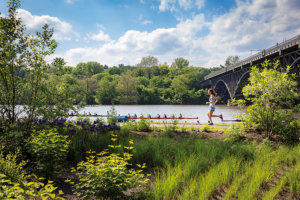
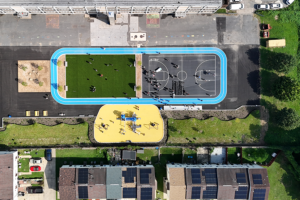
The Beloved Rivers: OLIN’s commitment to our backyard includes the Schuylkill, the Delaware, and their vital tributaries. Our Plan for the Central Delaware enhances urban ecology and social equity along 7 miles of waterfront, while the new Sustainability and Resilience Plan tackles climate mitigation head-on. At South Wetlands Park, derelict piers are transforming into extensive, bio-diverse wetlands. Water Works Park and the East Park Canoe House dip OLIN’s toes into the Schuylkill, while the 30th Street Station Plan and Centennial Plan envision expanses of dynamic public realm to the west. The City’s Rebuild initiative brought us to West Mill Creek and the city’s schoolyards—building engaging landscapes to uplift neighborhoods and families.
A kaleidoscope of projects, teaching, volunteer commitments, and real-life labs for research and innovation have made Philly our home. By continuing to recognize the deep knowledge of our local communities, we ensure our hometown remains a place that truly enhances life for everyone.
As OLIN turns fifty, we reflect on our studio’s ethos in the context of our country’s democratic experiment, launched on July 4, 1776. While the struggle for equality and justice is unfinished, our Bill of Rights enshrines a critical ideal: Freedom of Assembly. Bringing people together without fear, and secure in each other’s company, is the bedrock of a resilient public realm—the starting point for a more perfect union.
OLIN’s landscape design for the Ellis Island New American Immigration Wall of Honor transforms the historic immigrant processing center site into a welcoming park honoring the country’s legacy as a land of promise and bastion of freedom.
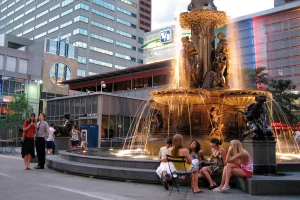
Cincinnati’s Fountain Square and NYC’s Bryant Park leverage central, civic spaces to foster public gathering, where all scales of occasion are made vibrant and comfortable with shading trees, beautiful plantings, a balance of movement and pause, and where visibility confers a sense of invitation and safety, inducing communication and a sense of security. At our landmark restoration of Bryant Park, we championed movable tables and chairs—so the public can orchestrate how they gather, constantly re-creating their own environment for assembly.
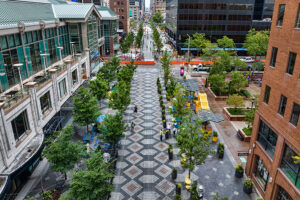
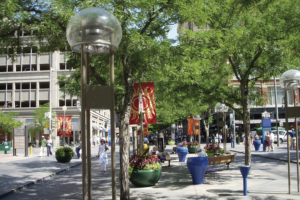
And what better way to privilege public assembly than through streetscapes redesigned as pedestrian-centric realms? Beginning with Denver’s 16th Street Mall in 1982, OLIN has led the conversion of vehicular ways, weaving public realm directly into the urban grid. Through ongoing analysis and refined frameworks for success, four decades later we’ve directed bold, forward-looking updates infusing the 16th Street Mall with fresh energy and activation.
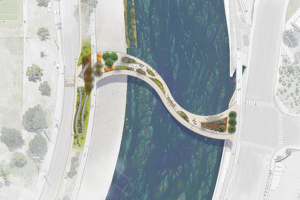
This legacy of fostering public assembly and urban connectivity culminates in Washington DC’s 11th Street Bridge Park Reclaiming a decommissioned highway across the Anacostia River, this project brings disparate neighborhoods together through an innovative, community-driven co-creation process and an Equitable Development Plan. Here, local cultural meaning and expression infuse the destination landscape—where the health and prosperity of the community grows alongside the health of the river.
“America the Beautiful” conjures our love of country, encouraging us to preserve, restore, and steward our lands. Some 640 million acres are entrusted to 4 agencies who manage our natural, historical, and cultural treasures with implicit responsibility in the protection, health, and wellbeing of our citizenry. So OLIN leverages federal initiatives to realize America the Beautiful and our central mission, Creating Places That Enhance Life.
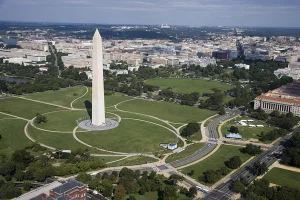
The Washington Monument set on 72-acres is an iconic ground of American memory, speech, and aspirational ideals. In the early 2Ks, OLIN leveraged a terrorism prevention project to secure the hallowed grounds, not through a wall of protection, but through the welcoming gesture of a sweeping bench holding a plateau of common ground—a civic amenity and place for peaceful assembly, inviting tourists and welcoming worldwide allies to the US capital and its many landscapes of national commemoration.
In Cleveland, at the Anthony J. Celebrezze Federal Building Plaza, OLIN introduced an urban forest to shield visitors from harsh Lake Erie winds. With majestic trees, gently winding paths, and generous gathering space, the civic grounds echo a native Midwestern landscape while instilling a sense of protection and harmony with nature.
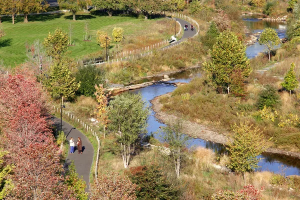
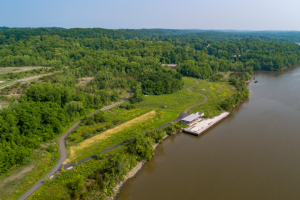
Federal dollars also support local enhancements that build beauty, comfort, and connectivity. Mill River and Greenway in Stamford turned a channelized, polluted waterway into a riparian valley—a new park oasis for urban flood resilience, receiving an APA, Great Places in America, Great Public Spaces award.
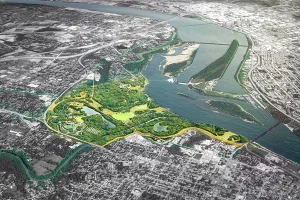
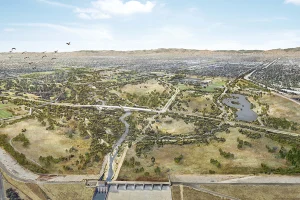
Throughout US history, forests and fields have been desecrated by unbridled expansion and waste. From Sea to Shining Sea, OLIN advocates for innovative land reclamation and carbon reduction to end encroachment into rural and natural resources. Origin Park, a former brownfield on the Ohio River, will regenerate ancestral forest and receive floodwaters to rebuild ecosystem services. OLIN’s hallmark Dilworth Park reclaimed a 70’s era, forbidding plaza as a universally accessible park infused with art and gardens to reduce heat island, encourage public transit use, and foster connection—through culture and nature.
As DIY environmentalism, Civic Ecology improves degraded conditions while regenerating communities around them. The nation’s 250th prompts us to consider an expansive approach—asking how we can infuse our work with the purpose and innovative spirit of the Civic Ecologist—to foster stewardship, resilience, and connection to place. How might our acts accrue to the scale of real impact, shifting perceptions and bolstering arguments for environmental policy?
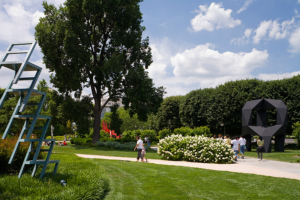
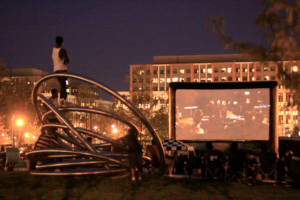
OLIN plays Civic Ecologist at two projects in our nation’s capital. Our contributions to DC’s National Gallery of Art Sculpture Gardenover the decades turned an overlooked cultural space into a showcase of American identity. The garden matured into a sheltering, native bosque where an active public may now explore exceptional contemporary art …or skate the fountain. It blossomed into an engaging, American landscape that is free to all. Nearby, Washington Canal Park transformed a former bus lot into a public park, informing and inspiring a movement to de-pave our urban centers. As a model integration of ecological design, it received one of the first Sustainable Sites Certificates. Our innovative collaboration with the Penn Urban Health Lab and USFS Philadelphia Field Station through the Nature and Well-Being Project promotes Civic Ecology through a ‘kit of parts’ for communities to retake their forsaken properties.
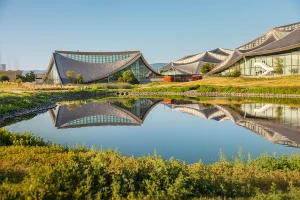
Data from these projects advances OLIN’s work in post-occupancy design, while subsequent projects continue to inform our innovation-centered practice. On the Hudson River in NYC, Pier 26 demonstrates the island’s indigenous ecotones, the force of today’s tidal river flows, and the ecology that can be fostered, both in the water and upon its urban riverbanks. Further up the Hudson, Sojourner Truth State Park in Ulster County recovers nature on a former 520-acre quarry complex to reveal its ecological and cultural past, foster adaptation, and promote ongoing stewardship through engagement and programming.
It is through such open space reclamation and infrastructure that we strive to more expansively foster citizen engagement to reclaim places, so people can safely gather, develop community, and thrive.
During this US semiquincentennial, we recall projects across OLIN’s 50 years demonstrating American values we hold dear. Service to our country takes many forms, entailing self-sacrifice on behalf of our citizenry. Such engagement in our democracy inspires us as we interpret acts of valor through commemorative landscapes—immersive environments that spark curiosity, leading to better understanding, compassion, and even awe.
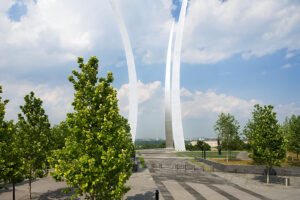
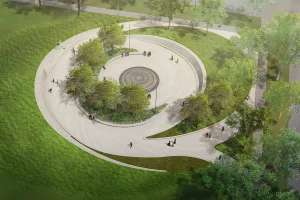
OLIN’s landscape for the Air Force Memorial organizes the experience to evoke an emotional response in visitors contemplating the power of an Air Force mission alongside the heartbreak of lost lives. The National Veterans Memorial and Museumis dedicated to those from all military branches who defend our country. There, the circular, undivided landscape heals by bringing people together, compelling shared reverence for our protected freedoms. The Desert Shield and Desert Storm Memorial expresses purpose—even beyond the military operation and liberation of Kuwait—to address our healing as a nation following conflict and to elevate the historic diplomacy: global cooperation, shared service, and sacrifice.
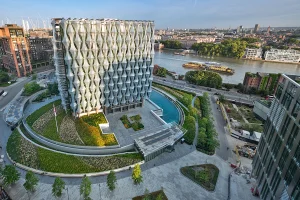
Service across our three branches of government and diplomatic corps is commemorated through place naming or monuments, and values are expressed through design at presidential libraries, embassies, and consulates. By establishing a sense of transparency, openness, and equality, the U.S. Embassy London’s landscape gives form to our countries’ shared, core belief in democracy. Presidential Libraries are more than monuments to each administration, they can leverage values that first began in service through Presidential Leadership. The Truman Library and Museum Grounds design in Independence, Missouri, leverages the institution’s landscape, and even ties into the region’s trails, to more fully express President Truman’s complex legacy through engaging walks.
OLIN is at the table, lending our voice as national principles and ideals are defined, and interpreting those into built form that will uphold the sincerest and most noble of American values, which align with our mission.
Democracy is a precious and practical framework granting us authority and responsibility to guide our government along the path charted in its founding documents which decree freedom, equality, and protection of civil liberties. Justice—fair application of freedoms and liberties—is central to OLIN’s purpose of enhancing life, believing that it can be advanced through the physical design of our public landscapes.
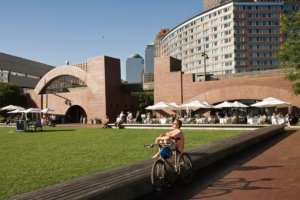
At Independence National Historical Park, the OLIN-led ’97 plan and grounds redesign elevates treasured resources symbolizing the U.S. as the birthplace of democracy; at the John Joseph Moakley US Courthouse and Harborpark we set a civic stage, establishing precedent for an active public in the realm of the law.
We nurture alignments with clients and projects to express values we esteem and advance our commitment to inclusive design, knowing that true democracy requires physical, universal access and honest narrative landscapes. The Gang of 19 Tribute Commons at Denver Civic Center Park injects accessibility at a ceremonial gateway, celebrating the nearby 1978 civil disobedience which helped secure the Americans with Disabilities Act—so impactful within our discipline.
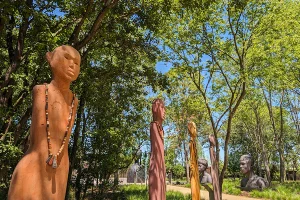
Honored to be engaged by the Equal Justice Initiative, we support their truth-telling mission at EJI Legacy Site Freedom Monument Sculpture Garden on the Alabama River, where magnificent cultural expression relates the history and experience of this country’s horrific slave trade through a curated landscape journey.
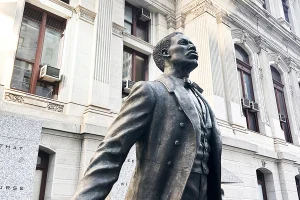
Perhaps this project most beautifully reflects OLIN as a proponent of Democracy and Justice: in 2014 we collaborated with artist Branly Cadet to locate the powerful Octavius V. Catto Memorial at the northern terminus of Philly’s Avenue of the Arts, right at the entrance to City Hall, to appropriately celebrate Catto’s life dedicated to the abolition of slavery, the right to vote, and the establishment of equal rights. Like Catto, we aspire to be agents of change—Creating Places that Enhance Life—for All.